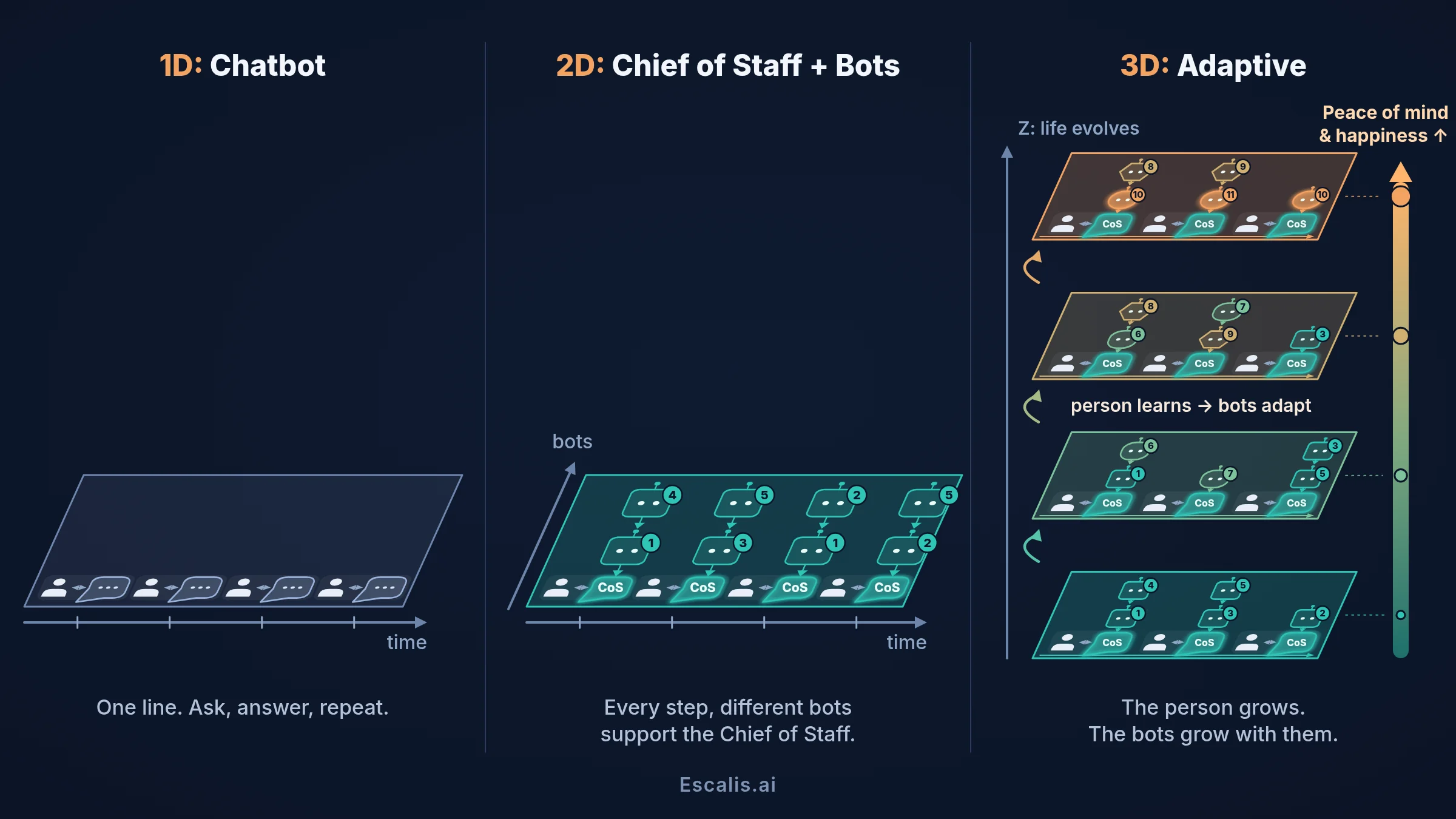
1D: the chatbot, and why it keeps you busy
The left panel is how most people and most companies use AI today. You type a question, the chatbot answers, you read it, you type the next question. One line, moving through time. Every exchange stands on its own. The chatbot waits for you, knows little about your bigger picture, and nothing happens unless you start it.
It is useful, but it is slow. You are still the engine. You copy answers into emails, check them, paste them into documents and chase the next step yourself. When you close the laptop, the work stops. AI saves a few minutes here and there, and then costs an hour of prompting, checking and correcting. That is the 1D world: low productivity and a lot of time at the keyboard. It is where most companies are stuck today.
2D: a Chief of Staff and a team of bots
The middle panel adds a second axis. You still move forward through time with one point of contact, your Chief of Staff (CoS). But behind every step there is now a team of specialist bots. In the picture, bots 1 and 4 help at the first step, then 3 and 5, then 1 and 2, then 2 and 5. Different work, different specialists.
This is how I run Escalis.ai today on Grok Bot. Each bot is first trained in its own domain: mail, CRM, lead research, finance, content, travel. After that I talk only to the Chief of Staff, who brings in the right bots at the right moment, and they pass work to each other. They keep working while my laptop is closed. At 8 in the morning my brief is ready, with what is done and what needs my OK. I approve every send.
In 2D you no longer do the work yourself. You steer it.
The difference is not a smarter answer. It is a different way of working. Serial becomes parallel. A quote that used to wait for a free afternoon now goes out within the hour after a meeting, and the follow-ups are drafted before I wake up.
3D: adaptive, a system that grows with you
The right panel stacks that 2D picture into layers along a third axis: your life as it evolves. Each layer is the same system of Chief of Staff and bots, but the bots change from layer to layer. New bots appear (6 and 7, then 8 and 9, then 10 and 11), others step back, and roles shift.
That is not because the person is unstable. It is because they learn. When the daily grind runs itself, you start to see your business and your life differently. You take on new projects, drop old habits, open a new market, maybe move country. Your needs change. In 3D, the bots change with you. It is a loop: the person grows, and the bots grow with them.
For the people using it, that will be an amazing experience. Not a tool you keep configuring, but a team that already understands where you are going.
The real challenge for AI companies
Today, moving from one layer to the next is still manual. I notice that a new kind of work keeps coming back, I decide a new bot is needed, and I train it. That works, and it is what I help clients do. But it depends on the person seeing the need first.
The next step is for AI companies like Grok Bot to bring us into the adaptive 3D world. The real challenge is not a bigger model or a faster answer. It is whether the system can sense that your needs are changing, and then create new bots that match them. Noticing that you spend more time on a new market, a new type of client or a new part of your life. Proposing the right specialist, training it on your own work, and retiring the bots you no longer need. All while you stay in control and approve what goes out.
Whoever solves that well turns AI from productivity software into something much more personal: support that helps people reach higher levels of peace of mind and happiness.
Why peace of mind and happiness are the goal
Look at the bar on the right of the picture. With every layer, peace of mind and happiness rise. Step by step, not only at the end.
That is the real measure. Not how complex the technology is, but how much weight it takes off your shoulders. When the daily grind is done, you close the laptop at night knowing nothing is forgotten. No worrying over dinner about the call you missed. You finally get to the helicopter-view work you never had time for: strategy, your best clients, your family, your health. The Escalis.ai mission is to make business leaders more successful and happier, with peace of mind. The three dimensions are the road there.
How Escalis.ai guides you through the transition
You do not need to wait for 3D. The jump from 1D to 2D is concrete, doable now, and the biggest win. But it is a change in how you work, not just a new app, and that is where most people get stuck on their own. Escalis.ai guides you through it, step by step, and holds your hand until it runs.
- Where are you today. We start with an honest look at how you and your team use AI now, and where your days go: mail, planning, follow-up, quotes, admin, reports. That shows which work should move first.
- Advice and setup of your 2D team. I advise on the right setup and implement it with you: a Grok Bot Chief of Staff, plus specialist bots for the domains that matter in your business. Each bot is trained on your real work, in your language and your tone.
- Connected to your own tools. We connect your mail, CRM and calendar, in your own accounts. Your data stays with you, you stay signed in, and you approve every external send.
- Routines that run overnight. We set up the routines that work while your laptop is closed, so your morning brief is ready at 8 with what is done and what needs your OK.
- Coaching, so you steer instead of doing. The hardest part is a new habit: speak instead of type, give the work away, check the result and push back when it is wrong. I coach you until steering feels normal.
- Alongside you toward 3D. When your needs change, we add, retrain or retire bots together. That is the hand-held version of 3D today, and I stay alongside you as the adaptive tools arrive.
It starts with the Fast Track: Day 1 and an optional Day 2, 1.5 hours each, to get your Chief of Staff and first bots running. From there you choose how far you want to go.
Want to see 2D at work? The Grok Bot case study shows how I run my own business this way, and the live traffic case study shows the bot team as an office building, with every handoff as a moving dot.